


-49% Hot
Price range: ₹359.00 through ₹699.00

-43% Hot

Original price was: ₹699.00.₹399.00Current price is: ₹399.00.
-44% New

Price range: ₹249.00 through ₹449.00
-53% Hot
Price range: ₹300.00 through ₹470.00
 Vegan Food
 Baby & Mom
 Beauty
 Fashion
 Pet & Animal Care
 Health & Wellness
 Home & Cleaning Essentials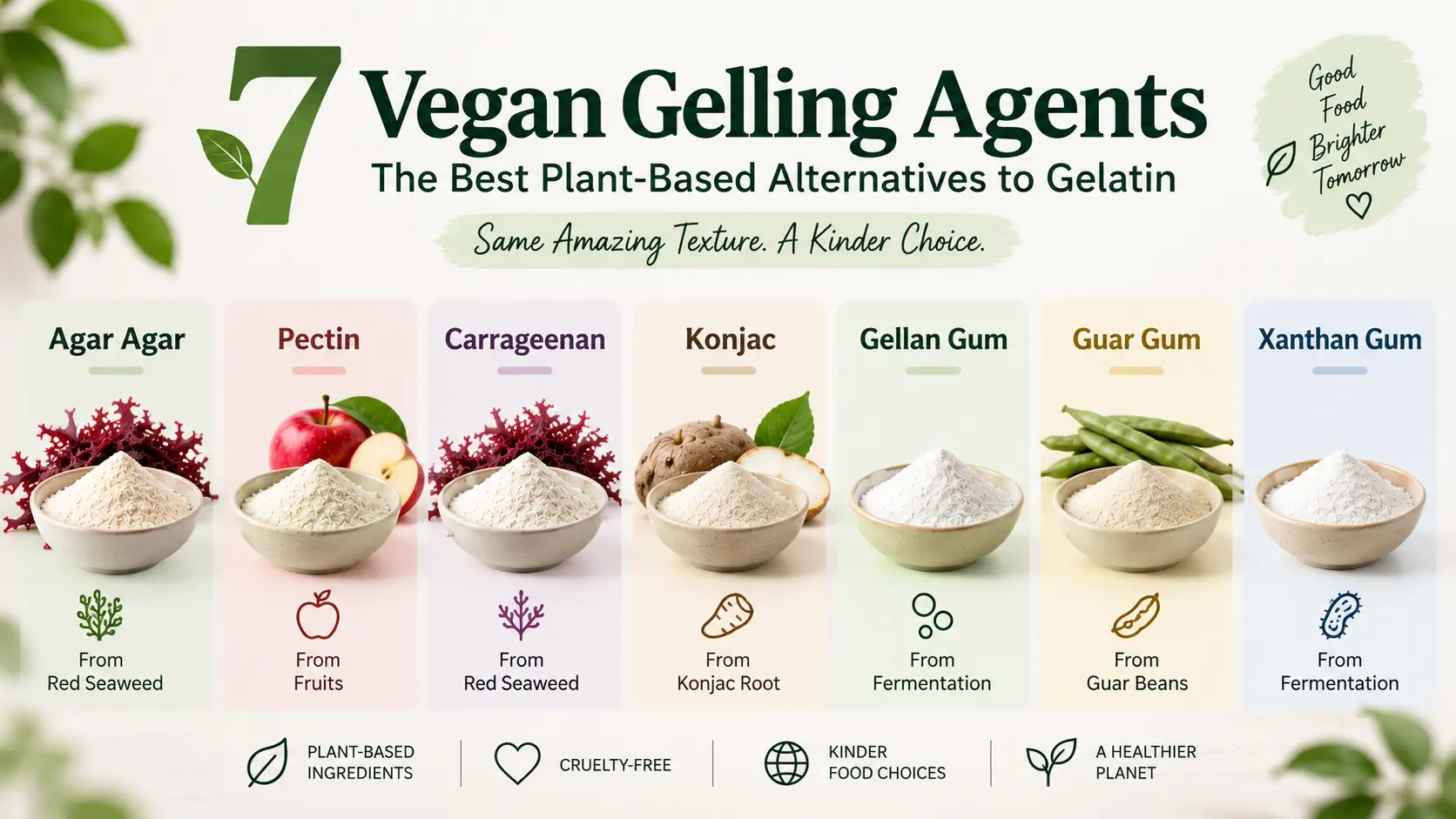
Vegan gelling agents are plant, algae, or fermentation-derived ingredients that can create, thicken, or stabilize gels without relying on animal-derived gelatin. That's the short answer. The longer, more useful answer is this: there isn't one perfect vegan replacement for gelatin. The best choice depends entirely on what you're actually making — a firm jelly, a creamy panna cotta, a chewy gummy, or a pourable sauce all call for a different ingredient, because these seven alternatives don't behave the same way, come from the same source, or even do the same job.
That last point is where most articles on this topic fall short. Most competitors answer "what are the alternatives to gelatin?" and stop there. This guide goes further, answering which vegan gelling agent you should actually use, why it behaves the way it does, and where to find or identify it if you're shopping in India specifically.
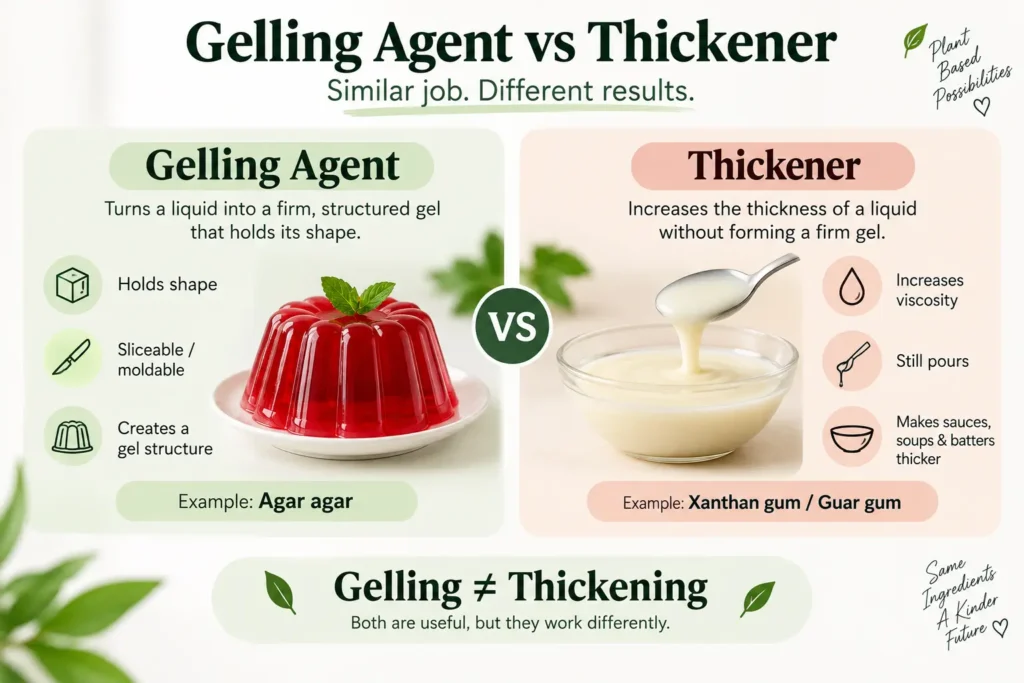
A gelling agent is any ingredient that causes a liquid to set into a semi-solid, structured gel — think of how a liquid jelly mix firms up into something you can slice or hold its shape. A vegan gelling agent does this same job using a plant, algae, or microbial fermentation source instead of animal collagen.
It's worth separating two words that get used almost interchangeably but aren't quite the same thing: gelling and thickening. A gelling agent creates a structured, often sliceable or moldable set — a jelly holds its shape when turned out of a mold. A thickener increases a liquid's viscosity without necessarily creating that same firm, structured set — a sauce becomes thicker, but it still pours and doesn't hold a shape on its own. Several ingredients on this list, like guar gum and xanthan gum, fall more into the thickening category than true gelling, which matters a lot when you're choosing one for a specific recipe.
Gelatin isn't vegan for a straightforward reason: it's extracted directly from animal collagen — the connective tissue, skin, and bones of cattle, pigs, or fish — through a boiling and purification process. There's no plant equivalent of collagen, which is exactly why "vegan gelatin" isn't a single ingredient but a category of unrelated substitutes.
Those substitutes behave differently from each other because they're structurally different substances entirely. Agar and carrageenan are both extracted from red seaweed but form gels through different mechanisms. Pectin comes from fruit and needs specific conditions — usually sugar and acid — to set at all. Gellan and xanthan gum are produced by entirely different fermentation processes using different bacterial strains. There's no reason to expect them to act alike, and they don't.
This distinction is worth stating plainly: there is no single ingredient called "vegan gelatin" that behaves identically to animal gelatin. "Vegan gelatin" is a marketing and functional label applied to whichever plant-based gelling agent a product uses — most often agar agar — precisely because it performs a similar role in a recipe. It isn't a scientific equivalent, and it isn't one standardized ingredient the way animal gelatin is.
Gelling Agent | Source | Best For | Texture | Vegan |
Agar agar | Red seaweed | Jelly/desserts | Firm | ✅ |
Pectin | Fruit | Jam/gummies | Soft/tender | ✅ |
Carrageenan | Red seaweed | Creamy desserts | Soft/elastic | ✅ |
Konjac | Konjac root | Chewy gels | Elastic | ✅ |
Gellan gum | Fermentation | Precise gels | Clean/firm | ✅ |
Guar gum | Guar beans | Thickening | Viscous | ✅ |
Xanthan gum | Fermentation | Stabilizing/thickening | Thick | ✅ |
Not all seven of these are direct gelatin substitutes. Some — particularly guar gum and xanthan gum — are more accurately described as thickeners or stabilizers rather than true gelling agents, and using them expecting gelatin-like results is one of the most common mistakes people make with this category, covered later in this guide.
Agar agar is a hydrocolloid extracted from the cell walls of red seaweed species, primarily from the Gelidiaceae and Gracilariaceae families. It carries the European food additive code E406, and has been used as a food-grade gelling agent for roughly 300 years — longer than most other hydrocolloids extracted from marine algae, including carrageenan.
Once dissolved in boiling water, agar's polysaccharide structure cools and reforms into a rigid gel network. Unlike gelatin, it needs a genuine boil to activate fully, not just warm water.
In Indian markets, agar agar is widely sold as a powder, and is one of the most easily available vegan gelling agents on general grocery shelves, not just specialty stores.
These are the same product. "China grass" is simply the more commonly used consumer-facing name for agar agar across Indian markets, particularly in strip or flake form, while "agar agar" tends to appear more often on powder packaging.
Jelly, panna cotta, puddings, general desserts, and vegan cheese, where a firm, sliceable set is the goal.
Firm and slightly brittle, with a clean break rather than gelatin's soft, elastic wobble.
Agar needs to be brought to a full boil in liquid — typically for a minute or two — to dissolve properly, then left to cool and set at room temperature, which it does without needing refrigeration.
Agar sets reliably at room temperature and holds up in warm conditions far better than gelatin does, which makes it genuinely useful in hot climates. Its limitation is texture: it can't replicate gelatin's soft, melt-in-the-mouth quality, and it doesn't perform well in very acidic mixtures, where its gelling strength can weaken.
Pectin is a structural polysaccharide found naturally in the cell walls of fruit, particularly concentrated in the peels and cores of citrus fruits and apples. It carries the food additive code E440.
Yes. Pectin is entirely plant-derived, with no animal involvement in either its natural source or its commercial extraction process.
This distinction matters more than most people realize. High-methoxyl (HM) pectin — the more traditional, widely available form — requires a specific combination of sugar and acid to set properly, which is why classic jam recipes rely on generous sugar quantities. Low-methoxyl (LM) pectin, by contrast, has a lower degree of esterification and sets using calcium ions instead of relying on sugar, which is why it's the preferred choice for lower-sugar jam and jelly recipes.
Depending on the type, pectin generally needs the right combination of sugar and acid (for HM pectin) or calcium (for LM pectin) to form a proper set — simply dissolving it in liquid on its own generally won't produce a gel.
Jam, marmalade, fruit jelly, and gummies, where its natural pairing with fruit acidity and sugar works with the recipe rather than against it.
Soft and tender, with more give than agar's firmer set.
Pectin's dependence on sugar, acid, or calcium (depending on type) makes it less flexible than agar for savoury or low-sugar applications, and getting the ratio wrong can result in a gel that's too soft or that never sets at all.
Carrageenan is another hydrocolloid extracted from red seaweed, carrying the food additive code E407. Despite sharing a seaweed source with agar, it's structurally distinct and behaves quite differently.
Yes. It's entirely algae-derived, with no animal-sourced components.
These three types differ based on their sulfate content and resulting gel behaviour. Kappa carrageenan forms a firm, somewhat brittle gel and is commonly extracted from Kappaphycus alvarezii seaweed. Iota carrageenan forms a softer, more elastic gel and typically requires calcium to develop its set properly. Lambda carrageenan doesn't gel at all — it functions purely as a thickener, adding viscosity and body without creating a structured set, which makes it useful in plant milks and creamy liquids rather than jellies.
Vegan panna cotta, plant-based milk, puddings, vegan cheese, and creamy desserts — kappa and iota types in particular are well suited to dairy-alternative applications where a smooth, creamy set is the goal.
Konjac gum, also called glucomannan, is extracted from the root of the konjac plant, a starchy tuber traditionally used across East Asian cooking. Its gelling behaviour is distinct from the seaweed-derived agents above — it forms an elastic, distinctly chewy gel rather than a firm or soft one, which is exactly why it's a popular choice for gummies and noodle-style products (konjac noodles being a well-known example on their own). Beyond desserts, konjac's gel-forming properties have also made it a common textural component in some plant-based meat alternative products, where its chewiness helps mimic the bite of animal protein.
Gellan gum, carrying the food additive code E418, is produced through microbial fermentation of a carbohydrate source by the bacterium Sphingomonas elodea (previously classified as Pseudomonas elodea), a strain first isolated from lily plant tissue found in a pond in Pennsylvania. This fermentation origin sets it apart from the seaweed and fruit-derived agents earlier on this list.
Gellan forms strong, clean-textured gels even at very low usage concentrations, and notably produces gels that remain stable at higher temperatures rather than melting the way gelatin or even agar can under heat. This heat stability, combined with its ability to create precise, clear gels, has made gellan gum popular in industrial and commercial food production — particularly in products requiring a very specific, consistent texture. It's encountered far less often by home cooks simply because it isn't typically stocked on general grocery shelves the way agar or pectin are, and it requires more precise measurement to use effectively.
Guar gum, food additive code E412, is a galactomannan polysaccharide extracted from guar beans through a mechanical dehusking, hydrating, and milling process. Unlike the agents covered so far, guar gum is primarily a thickener and stabilizer rather than a direct gelatin replacement — it increases viscosity and helps prevent ingredient separation, but it doesn't create the same kind of structured, sliceable gel that agar or pectin can.
Guar gum shows up frequently in ice cream (where it helps control ice crystal formation and improve texture), sauces, plant-based milk products, and gluten-free baking, where it helps provide some of the binding structure that gluten would otherwise supply.
Xanthan gum, food additive code E415, is produced through bacterial fermentation of a carbohydrate source — commonly corn starch — using the bacterium Xanthomonas campestris. Like guar gum, it's worth being direct about its role: xanthan gum is excellent at thickening and stabilizing, but it is not a direct substitute for gelatin in most recipes, since it doesn't form the same kind of firm, structured gel.
Its main strengths are in thickening liquids, stabilizing emulsions to prevent separation, and providing structure in gluten-free baking. It's a common ingredient in sauces, salad dressings, and a wide range of vegan recipes where a smooth, consistent texture matters more than a moldable set.
If you're making... | Best choice |
Jelly | Agar |
Jam | Pectin |
Fruit gummies | Pectin |
Firm panna cotta | Agar |
Creamy panna cotta | Carrageenan |
Chewy gummies | Konjac or pectin blends |
Vegan cheese | Carrageenan or gellan |
Plant milk | Carrageenan or gellan |
Sauce | Xanthan or guar |
Gluten-free baking | Xanthan or guar |
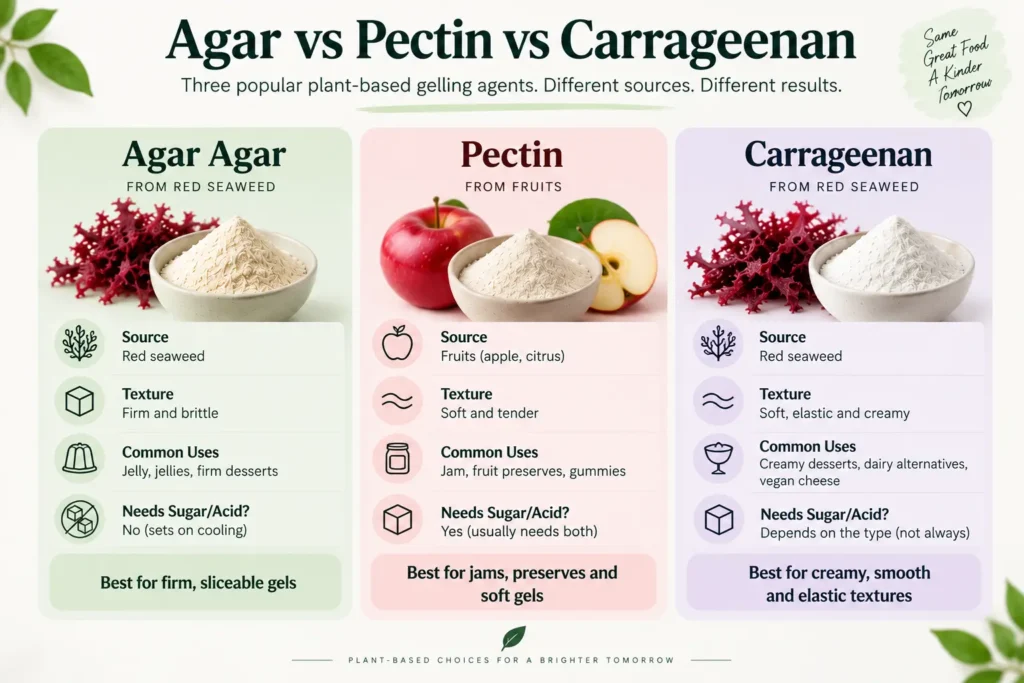
Feature | Agar | Pectin | Carrageenan |
Source | Red seaweed | Fruit | Red seaweed |
Best for | Firm gels | Fruit gels | Creamy gels |
Texture | Firm/brittle | Soft/tender | Soft/elastic |
Needs sugar? | Usually no | Depends on type | No |
Needs acid? | No | Often | Depends |
Vegan | ✅ | ✅ | ✅ |
India availability | High | Modera te | Moderate |
Not universally. This is worth being upfront about, because it's one of the most common points of frustration when people first switch to a vegan gelling agent. Each substitute has a different gelling strength, activation method, and ideal usage concentration compared to gelatin — agar, for instance, generally sets firmer than gelatin at an equivalent measured amount, while pectin's set depends entirely on sugar, acid, or calcium being present in the right proportions. There's no single conversion ratio that works reliably across every recipe and every brand of gelling agent, which is exactly why testing in small batches before committing to a full recipe is worth the extra effort.
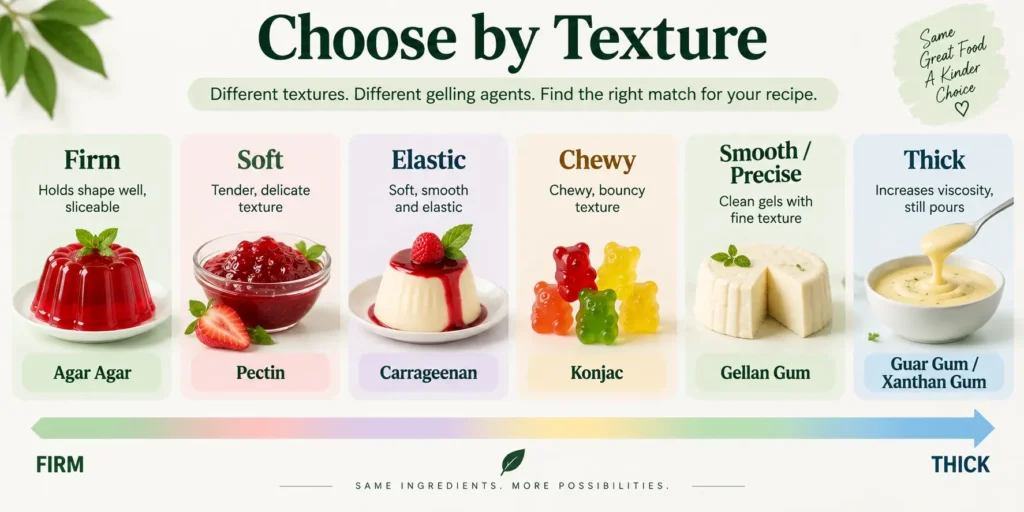
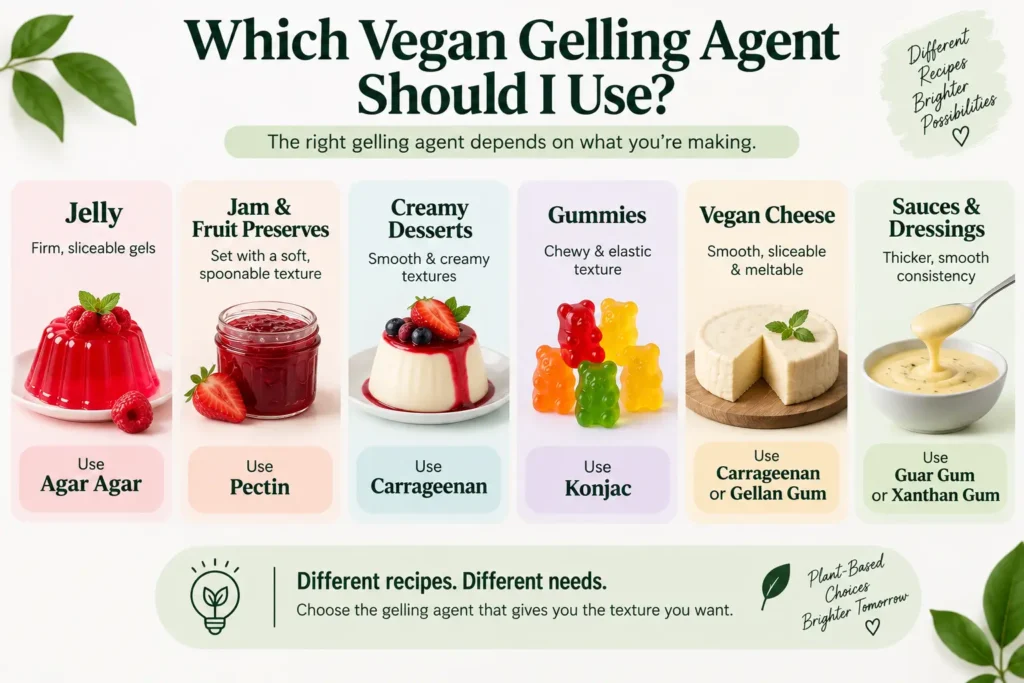
If you already know the texture you're after, this shortcut works well:
Agar agar powder is the most widely available vegan gelling agent across Indian grocery and online retail, sold under numerous local and international brand names.
The same ingredient as agar agar, more commonly used as a name in Indian markets — particularly for the strip or flake form rather than powder.
Less common on general grocery shelves than agar, but available through baking-specific suppliers, particularly for jam-making purposes.
Found occasionally in commercial dessert mixes, but generally requires a specialty ingredient supplier rather than a standard grocery store.
Look for these identifiers when checking a product's ingredient list:
Pectin's E-number and plant origin are well documented in current food-additive reference sources, making it one of the more straightforward ingredients to verify on a label.
Not necessarily, and this is worth being careful about. The core gelling ingredient itself — agar, pectin, carrageenan, and so on — is genuinely plant- or algae-derived in every case covered in this guide. But the finished product containing it isn't automatically vegan just because the gelling agent is. Blends, flavourings, colours, coatings, and other components of a finished commercial product can introduce non-vegan ingredients even when the primary gelling agent is plant-based. The only reliable approach is to check the complete ingredient list of the specific product, not just assume the gelling agent's vegan status carries over to everything else in the formula.
Mistake 1 — Assuming everything works 1:1. As covered above, there's no universal substitution ratio between gelatin and any of these alternatives, or even between the alternatives themselves.
Mistake 2 — Using agar without boiling. Agar needs a genuine boil to activate — simply stirring it into warm liquid the way you might with gelatin won't produce a proper set.
Mistake 3 — Using pectin without understanding sugar/acid/calcium requirements. Pectin's setting behaviour depends heavily on getting these supporting conditions right, and skipping this step is one of the most common reasons homemade jams fail to set.
Mistake 4 — Using xanthan as if it were gelatin. Xanthan thickens; it doesn't create the same structured, moldable gel gelatin does, and expecting it to behave that way leads to disappointing results.
Mistake 5 — Choosing the agent based only on "vegan." All seven ingredients on this list are vegan, but that alone doesn't make them interchangeable — the right choice depends on the texture and application you actually need.
Mistake 6 — Ignoring desired texture. Firm, soft, elastic, and chewy are genuinely different outcomes, and picking an ingredient without considering which texture you're after is one of the fastest ways to end up disappointed with the result. .
There’s no single best option — it depends entirely on what you’re making. Agar is the most versatile all-purpose choice for firm gels, but pectin suits fruit-based jams better, and carrageenan works best for creamy desserts.
Neither is objectively “better” — they’re different ingredients with different properties. Agar sets firmer and holds up better at room temperature, while gelatin has a softer, more elastic, melt-in-the-mouth texture that agar can’t fully replicate.
Yes. Pectin is extracted entirely from fruit, with no animal involvement in its source or production.
Yes. Carrageenan is extracted from red seaweed and contains no animal-derived components.
Pectin, sometimes blended with other gelling agents, is commonly used for fruit gummies, while konjac is a common choice when a distinctly chewy, elastic texture is the goal.
Agar agar is generally the go-to choice for a classic, firm jelly texture.
Agar agar is by far the most widely available and commonly used option across Indian markets, frequently sold under its local name, China grass.
Yes. China grass and agar agar refer to the same ingredient — China grass is simply the more common consumer-facing name used in Indian markets.
Not reliably. Agar generally sets firmer than gelatin at an equivalent measured amount, and the two require different activation methods, so a direct 1:1 swap without adjustment often produces inconsistent results.
A gelling agent creates a structured, often sliceable or moldable set that holds its shape on its own. A thickener increases a liquid’s viscosity without necessarily creating that same firm structure — the liquid still pours and doesn’t hold a shape independently.
Your choices can help protect innocent lives.
No spam. Only vegan tips, cruelty-free updates & animal awareness 🐾


 Vegan FoodBaby & MomBeautyFashionPet & Animal CareHealth & WellnessHome & Cleaning Essentials
No account yet?
Create an Account