


-49% Hot
Price range: ₹359.00 through ₹699.00

-43% Hot

Original price was: ₹699.00.₹399.00Current price is: ₹399.00.
-44% New

Price range: ₹249.00 through ₹449.00
-53% Hot
Price range: ₹300.00 through ₹470.00
 Vegan Food
 Baby & Mom
 Beauty
 Fashion
 Pet & Animal Care
 Health & Wellness
 Home & Cleaning Essentials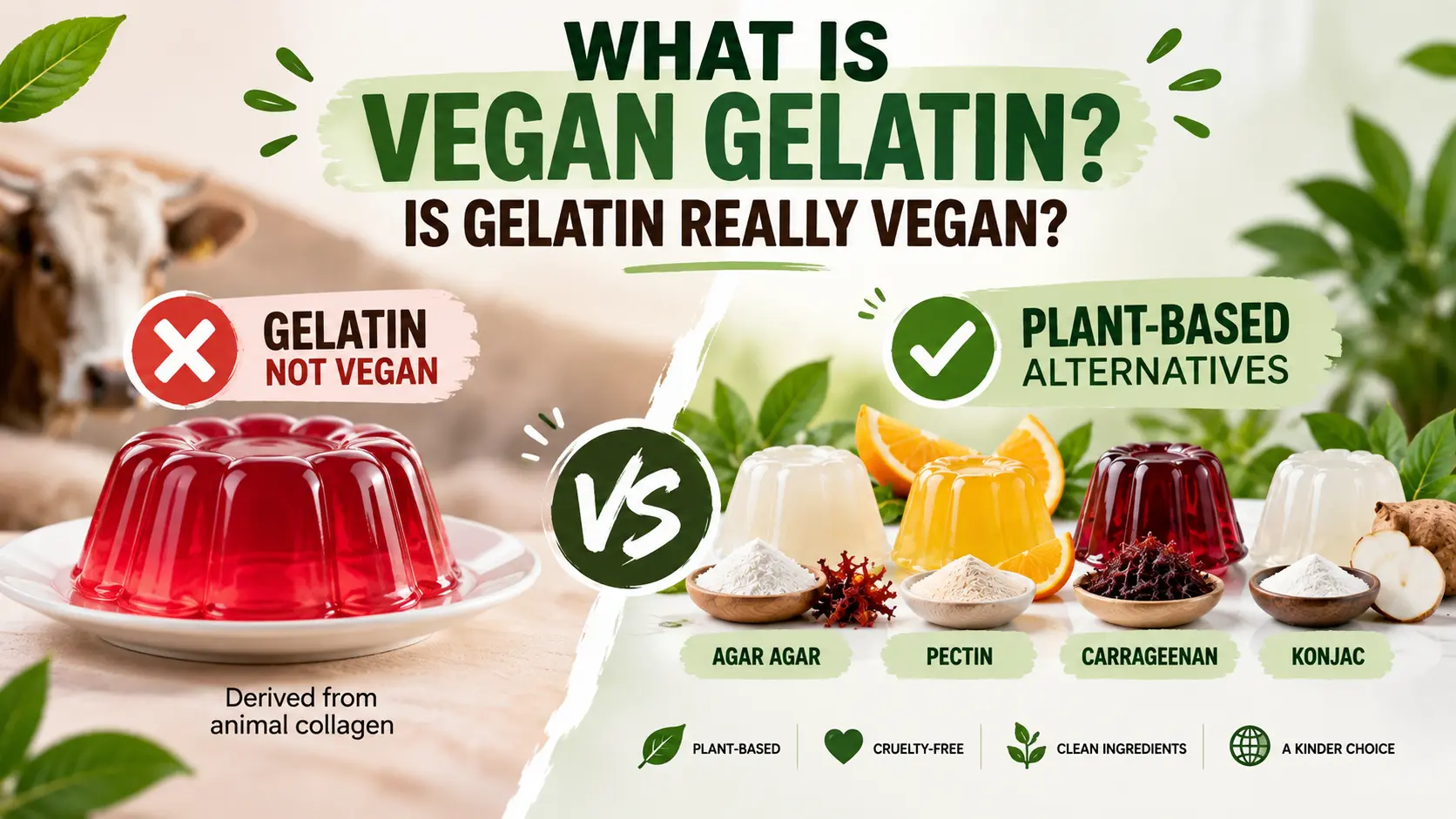
There is no true "vegan gelatin." Traditional gelatin is made from animal collagen, while the term "vegan gelatin" usually refers to plant-based gelling agents such as agar-agar, pectin, or carrageenan — ingredients that behave similarly to gelatin in a recipe but come from an entirely different source and aren't chemically the same thing at all.
That single distinction causes more confusion on Indian and international shelves than almost any other food-labelling issue. In this guide, you'll learn exactly why gelatin isn't vegan or vegetarian, what people actually mean when they say "vegan gelatin," seven real plant-based alternatives and where each works best, how to read a label well enough to catch gelatin hiding in unexpected places, and why terms like "veg gelatin," "gelatin-free," and "halal gelatin" don't mean what they sound like they mean.
No. Gelatin is an animal-derived ingredient, full stop, regardless of which animal it comes from.
Gelatin is a protein produced by boiling collagen-rich animal parts — skin, bones, tendons, and connective tissue — in water, which breaks the collagen down into a soluble, gel-forming protein. It's typically sourced from cattle (bovine gelatin) or pigs (porcine gelatin), though fish-derived gelatin exists too.
This is exactly why gelatin isn't vegan: it's extracted directly from animal tissue, not grown, fermented, or derived from a plant source. It also isn't vegetarian, for the same reason — vegetarian diets exclude animal flesh and by-products derived from slaughter, and gelatin is a direct byproduct of that process regardless of which animal supplied it.
Fish gelatin doesn't change this. Even though it's sometimes marketed as a "lighter" or more allergy-friendly alternative to bovine or porcine gelatin, it's still extracted from fish skin and bones — an animal source, which means it's not vegan and, depending on the specific vegetarian tradition being followed, generally not considered vegetarian either.
Here's the part that trips up a lot of shoppers: "vegan gelatin" isn't a single, standardized ingredient the way gelatin itself is. There's no plant equivalent of collagen that gets processed the same way animal gelatin does. Instead, the phrase is commonly used as an umbrella term for a handful of unrelated plant-based and algae-based gelling agents that happen to produce a similar textural effect:
Mostly for the shopper's convenience. Calling agar agar "vegan gelatin" on a product label instantly tells someone what job the ingredient does — gelling a dessert or jelly — without requiring them to already know what agar is. It's a functional description, not a scientific one.
No — and this is one of the most important distinctions in this entire topic. Gelatin is a specific protein, derived specifically from animal collagen through a specific extraction process. Agar agar is a polysaccharide extracted from red algae. Pectin is a polysaccharide found in fruit cell walls. Carrageenan is also extracted from red algae, but is structurally distinct from agar. None of these are gelatin in any chemical sense — they're simply alternatives that can often do a similar job in a recipe. Calling them "vegan gelatin" is a naming convenience, not a scientific equivalence.
Extracted from the skin, bones, and connective tissue of cattle. This is one of the two most common commercial sources of gelatin worldwide.
Extracted from pig skin and bones, and is especially common in gummy candies, marshmallows, and many pharmaceutical capsules, particularly in markets where pork-derived ingredients aren't restricted.
Extracted from fish skin and bones, and increasingly used as an alternative where bovine or porcine sources are restricted for religious, cultural, or allergy reasons — though it remains an animal product.
The process is more straightforward than it sounds. Collagen-rich animal parts are boiled in water over an extended period, which gradually breaks down the tightly wound collagen protein structure into smaller, water-soluble protein fragments. Once this liquid is cooled, filtered, and dried, it becomes the powdered or sheet gelatin found in supermarkets — the same protein, just extracted and purified from its original tissue.
Source: Red algae (seaweed), particularly species in the Gracilaria and Gelidiaceae families.
Best for: Jelly, puddings, panna cotta, and general dessert-setting where a firm, clean set is wanted.
Agar agar is also commonly sold in India as "China grass," and is one of the oldest documented plant-based gelling agents, with food use dating back centuries in East Asian cooking. Its botanical origin — extraction from the cell walls of red algae species, primarily in the Gracilaria and Gelidiaceae families — is well documented in reference sources such as Wikipedia's entry on agar.
Source: Fruit — particularly the peels and cores of apples and citrus fruits, which are naturally rich in this polysaccharide.
Best for: Jams, jellies, and gummies, where its natural pairing with fruit sugars and acidity works in the recipe's favour rather than against it.
Source: Red algae, extracted through a different process than agar agar despite sharing the same general source category.
Best for: Creamy desserts, plant-based milks, and puddings, where its softer, creamier set is often preferred over agar's firmer texture.
Source: The root of the konjac plant, a starchy tuber traditionally used in East Asian cooking.
Best for: Chewy textures, gummies, and jellies — konjac tends to create a distinctly springy, bouncy texture that's harder to replicate with the other options on this list.
Source: Corn.
Best for: Puddings, sauces, and general thickening — cornstarch isn't a true gelling agent in the way agar or pectin is, but it's widely used as a practical thickener in recipes that don't need a firm, sliceable set.
Source: The arrowroot plant's tuberous root.
Best for: Sauces, puddings, and fruit fillings, particularly where a glossy, clear finish is preferred over the slightly cloudy result cornstarch can sometimes produce.
Several brands formulate multi-ingredient blends — often combining agar, pectin, and other hydrocolloids — specifically designed to mimic gelatin's texture and set behaviour more closely than any single plant ingredient can on its own. These are typically marketed directly as "vegan gelatin" or "veg gelatin" powders, precisely because they're engineered to close the performance gap between plant ingredients and true gelatin.
Feature | Traditional Gelatin | Plant-Based Alternative |
Source | Animal | Plant/algae |
Vegan | ❌ | ✅ |
Vegetarian | ❌ | Usually ✅ |
Main protein | Collagen | Varies (polysaccharide-based) |
Texture | Elastic/soft | Depends on ingredient |
Examples | E441 | Agar, pectin, carrageenan |
Since agar agar is likely the substitute most people are actually trying to understand, it's worth giving it its own dedicated comparison.
Source: Gelatin comes from animal collagen; agar agar comes from red algae.
Texture: Gelatin sets into a soft, elastic, slightly bouncy gel that melts near body temperature — which is part of why gelatin desserts feel like they "melt in your mouth." Agar agar sets into a firmer, more brittle gel that doesn't have that same melt-in-mouth quality.
Activation: Gelatin is typically bloomed in cold water before being dissolved into a warm liquid. Agar agar generally needs to be brought to a boil to activate properly, and often requires a slightly longer dissolving time than gelatin.
Heat stability: This is one of agar's biggest practical advantages — it holds its set at room temperature and even in warmer conditions, while gelatin-based desserts will soften or melt if left out of the refrigerator too long.
Taste: Both are largely flavourless on their own, though agar agar can carry a very faint mineral or oceanic undertone in some preparations that gelatin doesn't have.
Common uses: Gelatin is common in Western-style jellies, mousses, and marshmallows. Agar agar is a staple in East and South Asian desserts and has become the standard gelatin substitute in vegan and vegetarian cooking more broadly.
Substitution considerations: It's worth being direct here — there isn't a universal 1:1 substitution ratio between gelatin and agar agar. The exact amount needed depends heavily on the specific recipe, the strength of the agar product being used, and the texture you're trying to achieve, since agar generally sets firmer than gelatin at an equivalent measured quantity. America's Test Kitchen's own side-by-side testing found that agar flakes and gelatin didn't behave identically even at carefully measured amounts, and that agar required a distinctly different preparation method — soaking, then boiling — to activate properly. Testing in small batches before committing to a full recipe is the safer approach.
This is worth addressing specifically because of how common the phrase is on Indian shelves. In Indian shops and online listings, "veg gelatin" is frequently used as a marketing or common name for vegetarian gelling agents — most often agar agar, sometimes blended with other plant hydrocolloids. It does not mean that actual gelatin has somehow become vegetarian; gelatin, by definition, cannot be vegetarian, because it's inherently an animal byproduct. "Veg gelatin" is simply a product naming convention that borrows gelatin's name for the function it performs, not for its actual composition.
The practical takeaway is the same one that applies throughout this guide: check the ingredient list on the specific product, rather than assuming the name tells you everything you need to know.
If you're shopping for a vegan gelling agent in India specifically, here's what typically shows up on shelves and what each one actually is:
The most important habit to build here is not relying on the product name alone. Two products marketed almost identically can contain meaningfully different ingredients — always read the actual ingredient list on the packet before assuming what you're buying.
A practical checklist for scanning any ingredient list:
E441 is the specific European food additive code that corresponds directly to gelatin. If you see this code on a European-labelled product, it refers to the same animal-derived ingredient as if the word "gelatin" appeared in plain text — current ingredient and food-additive guides, including the E-numbers reference database at Food-Info.net, consistently identify E441 as gelatin, regardless of which specific animal it was sourced from.
Sweets & candy
Desserts
Supplements
Other applications
Beyond obvious desserts and sweets, gelatin is also used more quietly as a stabilizer and texturizer in some processed foods — helping maintain consistency in products where you might not expect an animal-derived ingredient to appear at all. This is exactly why checking labels on less obviously "dessert-like" products still matters.
No — and this is a genuinely important distinction that's easy to miss. "Gelatin-free" only tells you that one specific ingredient has been left out. It says nothing about the rest of the formulation.
For example, a product can be entirely gelatin-free and still contain milk, whey, or other dairy derivatives — which makes it unsuitable for a vegan diet despite the gelatin-free label technically being accurate. In other words: gelatin-free does not automatically mean vegan. The only way to confirm a product is genuinely vegan is to check the full ingredient list for any animal-derived component, not just gelatin specifically.
No. Halal and kosher are religious dietary certifications, not indicators of an ingredient's plant or animal origin.
Halal gelatin typically refers to gelatin sourced from an animal permitted under Islamic dietary law and slaughtered according to Islamic requirements — commonly bovine gelatin from cattle slaughtered halal, since standard porcine gelatin is not permitted. Kosher gelatin follows a similar logic under Jewish dietary law. In both cases, the gelatin itself remains an animal-derived product; the certification addresses how and from which animal it was sourced, not whether it's plant-based.
Some halal or kosher-certified products do use plant-based alternatives like agar or pectin instead of animal gelatin specifically to sidestep this issue entirely — but that's a choice made by the individual manufacturer, not something inherent to the halal or kosher certification itself. The certification alone never confirms plant origin.
If you want to make... | Try... |
Jelly | Agar agar |
Jam | Pectin |
Gummies | Pectin, or a suitable vegan gelling blend |
Pudding | Agar agar or starch, depending on the recipe |
Creamy dessert | Carrageenan or a suitable thickener |
Chewy jelly | Konjac or pectin-based blends |
There's no single answer, since "vegan gelatin" is an umbrella term rather than one ingredient. It's commonly used to describe agar agar, pectin, carrageenan, konjac, or commercial blends of these.
No. Gelatin is always derived from animal collagen — typically from cattle, pigs, or fish — and cannot be considered vegan or vegetarian regardless of the source animal.
No. Vegan gelatin substitutes like agar agar or pectin are chemically unrelated to gelatin — they're plant or algae-based polysaccharides that can produce a similar textural effect, not the same protein.
It depends on what you're making. Agar agar is generally the most versatile all-purpose substitute, but pectin works better for fruit-based jams, and carrageenan tends to suit creamier desserts better than agar does.
Agar agar is one specific type of vegan gelling agent, and probably the most commonly referenced one, but "vegan gelatin" as a category also includes pectin, carrageenan, konjac, and various commercial blends.
No. Regardless of the country, gelatin is derived from animal tissue and doesn't meet vegetarian dietary standards. Products marketed with "veg" in the name, like "veg gelatin," typically refer to plant-based substitutes rather than actual gelatin.
E441 is the European food additive code that specifically refers to gelatin, regardless of which animal it was sourced from.
No. Bovine gelatin is derived from cattle, making it an animal product and therefore unsuitable for a vegan diet.
No. Despite sometimes being marketed as a lighter or different alternative, fish gelatin is still extracted from fish skin and bones, making it an animal-derived ingredient.
No. "Veg gelatin" is a marketing and common-use term in Indian markets typically referring to agar agar or similar plant-based gelling agents. It doesn't indicate the product contains any actual gelatin.
Your choices can help protect innocent lives.
No spam. Only vegan tips, cruelty-free updates & animal awareness 🐾


 Vegan FoodBaby & MomBeautyFashionPet & Animal CareHealth & WellnessHome & Cleaning Essentials
No account yet?
Create an Account